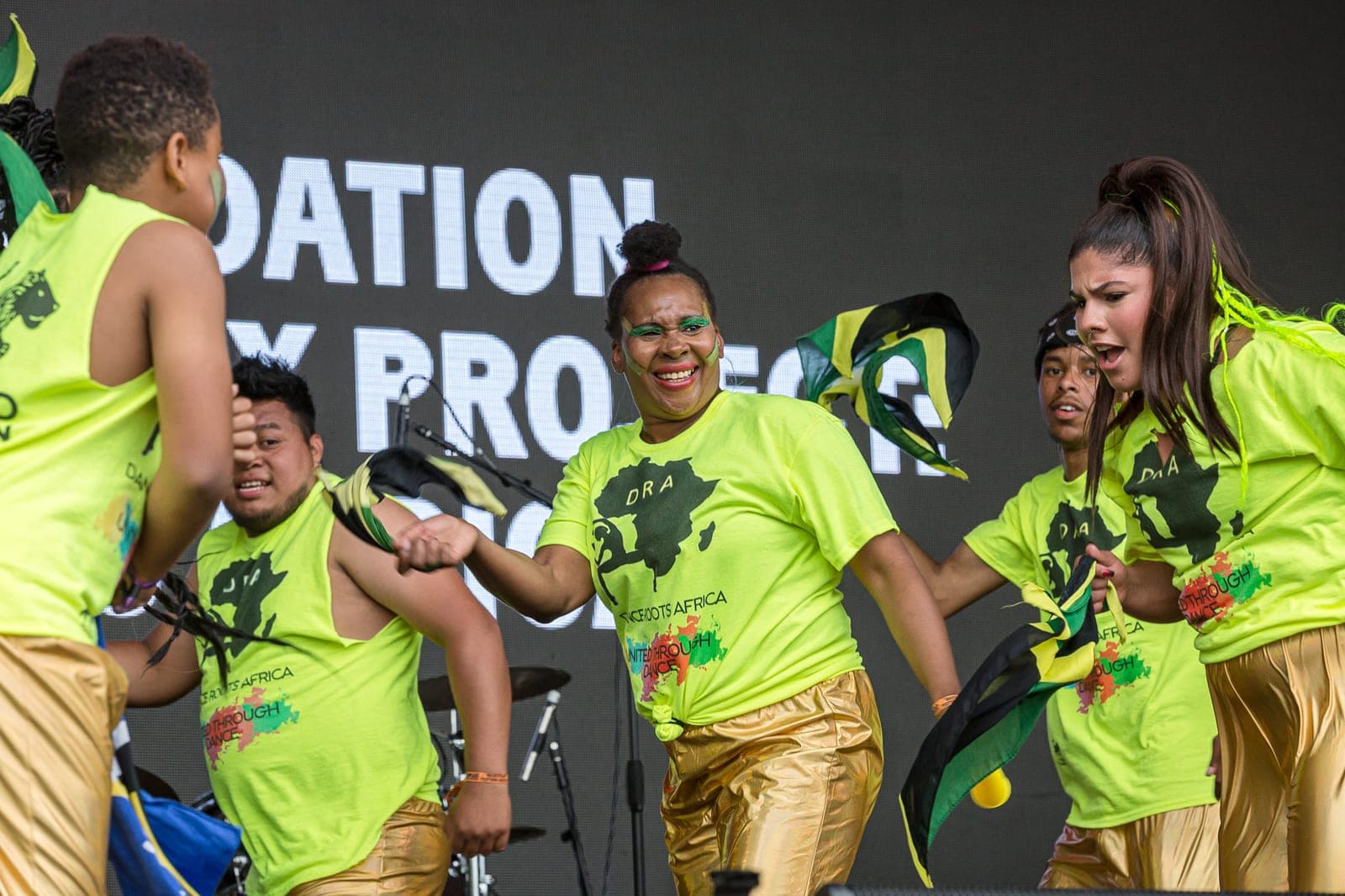
Twenty-three people needed help from medics at Ghana Party in the Park in Barnet on Saturday 1 August, after a gate that had been shut because of a fire was reopened onto a crowd that had built up behind it. Three were taken to hospital. The festival, which has run since 2005 and draws between 8,000 and 10,000 people each year, was closed for the day.
The Metropolitan Police set out the sequence in a statement issued to reporters. There is no named officer on it, and no named source anywhere on this story yet, so it is quoted here as what the force said rather than as anyone's personal account.
Shortly after 18:00hrs on Saturday, 1 August we were alerted to reports of crushing at the entrance to the Ghana Party in the Park event being held at the Copthall Playing Fields in Barnet. A small fire on the site, near to the entrance, had required the gates to be closed temporarily. A crowd built up and surged when the gates were reopened.
The London Ambulance Service said it was called at 6.08pm and sent ambulance crews, paramedics in fast-response cars, an advanced paramedic, its Hazardous Area Response Team and London's Air Ambulance. Police officers gave initial medical care, including CPR, before paramedics and firefighters arrived.
What the numbers actually say
The figure being repeated is 23, and it is worth being precise about what it counts. According to the account carried by the Press Association, 23 people received some form of assistance either from the emergency services or the event medical team. Nine of those were assessed by the London Ambulance Service. Three were taken to hospital, and their injuries were described as not life threatening.
So 23 is the number of people helped, not the number seriously hurt. That distinction matters, because the gap between those two readings is where a lot of the weekend's misinformation grew.
The rumours were wrong, and both the police and the organisers said so
Within hours, social media carried claims of a stabbing and of deaths. Both were untrue. The Metropolitan Police in Barnet said plainly that speculation about a stabbing was inaccurate, and the organisers addressed it directly in their own statement, posted to the festival's Instagram account the following day.
We are also aware of inaccurate information circulating on social media. We can confirm that there were no stabbing incidents at the festival and no fatalities occurred.
The same statement apologised and called the day one of the most difficult in the festival's history. The organisers said their thoughts were with everyone injured or distressed, and that they wish those hurt a full and speedy recovery. They have said they are committed to learning from the incident and will keep working with the authorities as the full circumstances are established.
The bit that is useful to anyone running a gate
Read the organiser's own published terms alongside the timeline and a queue-design problem comes into focus.
As published on the festival's own website at the time of writing, the event ran from 12pm to 9pm with last entry at 7pm, described as strictly enforced. There is a strict no re-entry policy: once you leave, you do not get back in. Every attendee is searched at the gate, and large bags are banned.
Now put the timeline against that. The crush happened just after 6pm. That is inside the final hour before a hard entry deadline, at a search point that necessarily processes people slowly, with no re-entry to soften the pressure, at a gate that had just been closed for a fire and then reopened in one go.
None of that establishes fault, and nothing here should be read as a finding. The authorities are the ones who will work out what went wrong. But the shape of it is familiar to anyone who has run a gate: a hard deadline concentrates arrivals, a search point meters them slowly, and a closure stores up the difference until something releases it.
Why this matters over the next few weeks
August is the month when the biggest outdoor crowds of the year assemble. Notting Hill Carnival marks its 60th anniversary over the bank holiday weekend of 29 to 31 August, and crowding there has already had money and attention thrown at it. The Mayor of London stepped in with £4.66m this year, on top of £946,300 already committed by City Hall, specifically to deliver safety improvements after an independent review. The funding covers increased barriers, stewarding and crowd management plans.
That is the context in which a gate failing at a 10,000-person festival in Barnet is worth more than a news-in-brief. For readers, there are a few practical things worth carrying into the rest of the season, none of which require anyone to stay at home.
- Check the last entry time when you buy, not on the day. A strictly enforced deadline is the single biggest driver of a late rush.
- Find out whether there is re-entry. If there is not, everyone has to get in on one pass, and everyone knows it.
- Arrive in the first half of the window if you can, especially at a searched gate.
- If a queue starts moving as a block rather than as people, keep your feet, keep your arms free at chest height, and move sideways out of the flow rather than against it.
We have written before about what weather actually cancels an event, and this is the other half of that: the things that go wrong at events are rarely the dramatic ones. They are gates, queues, timings and the gap between what a plan says and what a crowd does.
Further updates are expected through the festival's own channels. Anything else circulating should be treated with the same caution the stabbing rumour deserved.